
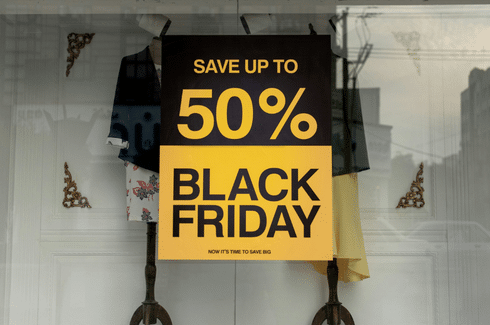
Black Friday began as an American retail campaign that has now evolved into a traditional retail custom and worldwide event.
Unfortunately, many of the deals or promotions on offer can also be found at the same price, or lower, at other times of the year, so discounts alone won’t set your brand apart. What will is getting the timing right, being relevant to your customer and engaging their attention.
Here are my top tips that you can implement to help support your Black Friday Marketing campaign:
1. Back it up with Paid Promotional Campaigns
Organic reach alone won’t carry over the noise of Black Friday, so put budget behind it early. Competition for ad space climbs in the weeks around the event, and costs can climb with it.
- Start warming up audiences with promotional messages in early November with search, paid social and display, then step up spend as the big day gets closer.
- Retarget people who browsed or abandoned a basket. They’re the warmest audience you have!
- Set budgets by channel and check in daily. Move money towards what converts and pause what doesn’t.
- Rotate your creative so the offer doesn’t feel stale by Saturday.
2. Segment by Performance, Purchase and History
One offer for everyone just wastes money. Segment your audience by behaviour, then tailor each group´s messaging. Segmentation ideas include:
- Performance: who opens, clicks and converts on your emails and ads, and who has gone quiet.
- Purchase: what they bought, how often, and how much they spend per order.
- History: loyal repeat customers, one-time buyers, lapsed customers and browsers who never bought.
Then match the message to the group. VIPs get early access, lapsed customers get a win-back offer, and big spenders may respond better to a bundle or free delivery than a percentage off. You also protect your margin by not handing your highest discounts to people who would have bought anyway.
3. Implement Limited-time Offers
A deadline is one of the oldest tricks in retail, and it still works because nobody wants to be the person who missed the deal. Considerations for building a limited-time offer includes:
- Setting clear start and end times and showing them everywhere: site banner, emails and ads.
- Layer your urgency across the weekend with early-bird offers, 24-hour flash deals and “while stocks last” drops.
- Ensure the deal is real. A fake countdown or an inflated “was” price will cost you trust, and in many markets, it can break pricing rules.
4. Measure every Promotion with its own tracked URL
If you can’t tell which promotion drove a sale, you can’t repeat it next year. Build UTM-tagged links for every email, ad, influencer post and affiliate placement to measure success. Also consider:
- Agreeing on a naming convention for source, medium and campaign up front so your reports stay clean.
- Create unique links or codes for each channel and each partner.
- Track what matters: conversion rate, revenue, average order value and return on ad spend, not just clicks.
- Check results during the campaign, not only afterwards. Mid-weekend data lets you shift budget while it still counts.
5. Publish SEO,GEO and AEO blogs that drive Black Friday search traffic
Shoppers start searching long before the day itself, so content that ranks early catches them while they’re still in the researching stage. You can increase your brand awareness and website traffic by including the following:
- Do your keyword research. Cover the big terms like “Black Friday deals”, then add category- and product-specific long-tail phrases such as “best [product] deals”.
- Write gift guides, deal round-ups and buying advice, and publish early so search engines have time to index them.
- Keep one evergreen Black Friday page and refresh it every year, rather than starting a new URL each time. It holds on to its authority.
- Link internally to your products and live promotions, and update the page as deals go live and sell out.
6. Expand your reach with Influencers and Digital PR
Other people’s audiences are the quickest route to engaging new shoppers, and a trusted voice often sometimes can generate better results than your own ad.
- Choose influencers whose followers match your customer (consider ages, locations, demographics, interests etc), rather than chasing the biggest follower count.
- Give each one an exclusive code or tracked link, so you can measure what they deliver.
- Pitch journalists and editors for gift guides and deal round-ups, and bring a real news hook such as an exclusive offer or a new product.
- Brief creators early. Their calendars fill up fast in November.
7. Pay Affiliates based on Performance
Affiliates can widen your reach while you only pay for results, which keeps the risk low.
- Recruit deals, cashbacks and content sites that fit your niche.
- Pay commission on sales or qualified actions. Consider a higher rate for top performers, or for the peak weekend, to win their attention.
- Hand partners what they need: banners, copy, product feeds and exclusive codes.
- Audit regularly. Watch for coupon sites that simply intercept a sale you would have won anyway.
8. Reward Subscribers with Exclusive Newsletter Offers
Your email list is an audience you own, so you should make the people who have signed up feel valued. This can include:
- Giving subscribers early access or deals that the general public can’t access.
- Using your segments to send tailored comms rather than one big generic blast.
- Plan a sequence: teaser, early access, live now, last chance. Keep subject lines clear about what’s on offer.
- Grow the list beforehand with a Black Friday sign-up page or waitlist, so you have more people to reach when it counts.
9. Build Excitement with a Countdown Launch
Treat Black Friday like a product launch; the campaign is not just a single day. Plan ahead by:
- Start teasing a week or two out with sneak peeks, “something’s coming” posts and a waitlist.
- Run a countdown on your site, emails and socials, then change it to count down to the end once the sale is live.
- Reveal deals in stages, such as a new category each day, to give people a reason to keep coming back.
- Get the basics ready: stress-test site speed, check stock levels and make sure customer service can handle the rush.
Why Shoppers love Bargains
Every tip listed above works better once you understand what’s going on in the shopper’s head. Some of it is marketing; however, a lot of it is simply human nature.
The marketing approach. Deadlines work. Research shows that a time-limited offer makes people more likely to buy, partly through fear of missing out and partly through the worry of regretting a deal they passed up. Prices play tricks on us too. We judge a number against the first one we see, so a crossed-out “was £80” next to “now £50” feels like a £30 win, whether or not the item ever really sold at £80.
The social pull. Even the most independent buyer is swayed by what everyone else is doing. Taking part in the same event at the same moment, even alongside strangers, can create a short burst of connection. That’s what a shared countdown, a trending hashtag or a “selling fast” notice taps into.
Sell Value, not just Discounts
The most effective Black Friday campaigns help customers feel good about what they bought long after the sale ends. The research here is worth keeping in mind.
- Buying to fit in, to gain status or to win approval is linked to lower wellbeing. Buying things that suit our personality and goals tends to go better.
- We often expect new purchases to make us feel better than they really do. In one study, people assumed new clothes would lift their confidence more than second-hand ones, yet the effect was about the same.
- People who ease off material goals and live more simply tend to get happier over time.
For us as marketers, that’s an opening. Be upfront about pricing, make returns easy, and write gift guides that genuinely help people choose something they’ll use and love. Where it fits your brand, lean into durable, repairable or second-hand options. Shoppers remember the brands that made them feel smart, not pressured.
Before you hit Black Friday, run through your campaign with this quick checklist:
- Budgets and paid campaigns scheduled, with retargeting ready
- Audience segments built and offers matched to each
- Start and end times set for every limited-time deal
- A tracked URL or code for every promotion
- SEO blog and evergreen Black Friday page live and linked
- Influencers, PR contacts and affiliates briefed with assets and codes
- Newsletter sequence and countdown scheduled
- Site speed, stock and customer service checked
If your brand needs last-minute Black Friday support, contact me today for a consultation!